
Appetite Control vs Fat Burners: What Works Better for Belly Fat?
Author: Ramzi Issa
Experience: 3+ years covering evidence-based weight management and behavior-focused health education
Reviewed by: Dr. Alwan Nadeem
Expertise: Metabolic health, preventive medicine, lifestyle-based weight management
A gentle reality check before we begin
If belly fat has been one of your most stubborn struggles, you’re not alone. Many people arrive at this question after trying hard: eating less, exercising more, or experimenting with different approaches that worked for others—but not for them.
In real-world settings, confusion often builds when progress feels inconsistent or temporary. Some people feel constantly hungry and blame their willpower. Others feel like their body simply doesn’t respond anymore, no matter what they do. Both experiences are valid, and neither automatically means you’re “doing something wrong.”
This article is designed to clarify—not hype—one common comparison: appetite control vs fat burners. The goal is not to push a single solution, but to help you understand which problem you’re actually facing, so expectations stay realistic and frustration stays lower.
What does “appetite control vs fat burners” really mean?
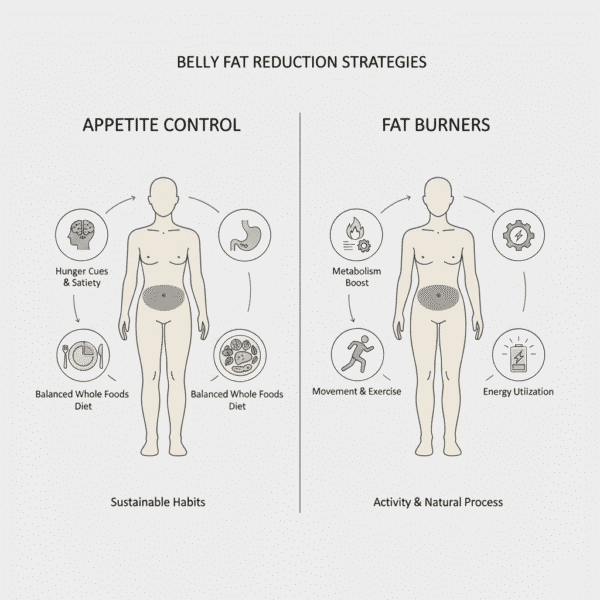
At a practical level, these two approaches target different bottlenecks in fat loss.
-
Appetite control focuses on reducing hunger, cravings, or constant thoughts about food.
-
Fat burners aim to influence how the body uses energy, often by slightly increasing calorie expenditure or fat oxidation.
Public health organizations such as the World Health Organization (WHO) and the U.S. Centers for Disease Control and Prevention (CDC) consistently emphasize that sustainable fat loss is primarily driven by energy balance and behavior—not supplements alone. Products, when used, are considered adjuncts, not foundations.
Understanding this distinction matters because using the wrong tool for the wrong problem often leads to disappointment.
When appetite is the real problem
Signs appetite control may matter more than fat burning
In practice, appetite-related challenges are commonly observed among people who experience:
-
Frequent snacking despite adequate meals
-
Evening or stress-related cravings
-
Difficulty stopping once eating begins
-
Feeling “hungry” even shortly after meals
These patterns are often influenced by sleep quality, stress hormones, meal composition, and routine consistency—not personal discipline.
Why appetite control can help belly fat indirectly
Belly fat is particularly sensitive to overall calorie intake over time. If appetite feels unmanageable, even small daily excesses can accumulate quietly.
Professional dietary guidelines, including those from the Academy of Nutrition and Dietetics, note that appetite regulation improves when meals include:
-
Adequate protein
-
Fiber-rich carbohydrates
-
Regular meal timing
In real-world settings, appetite control strategies—whether behavioral or nutritional—often help people stay consistent long enough for body composition changes to occur.
Important limitation to know
Appetite control does not override biology completely. Hormonal changes, medications, and medical conditions can affect hunger signals. This is why no single approach works universally.
When metabolism feels like the issue
Signs people often attribute to “slow metabolism.”
“This helps explain why belly fat is often more resistant to change than fat stored in other areas of the body.” Many people explore fat burners when they notice:
-
Minimal fat loss despite calorie control
-
Reduced results compared to earlier years
-
Fat loss everywhere except the belly
Clinically, metabolism does slow modestly with age, but not usually as dramatically as social media suggests. According to consensus statements from organizations like the National Institutes of Health (NIH), daily movement, muscle mass, and sleep often explain more variance than metabolism alone.
What fat burners realistically do
Most fat burners work by:
-
Slightly increasing thermogenesis
-
Enhancing fat oxidation during activity
-
Supporting energy or focus (often via caffeine or similar compounds)
In practice, the effect size is usually small. Fat burners may help support an existing routine, but they rarely compensate for inconsistent habits.
Why is belly fat often resistant?
Belly fat is influenced by insulin sensitivity, stress hormones (such as cortisol), and genetics. This means even when fat burners have an effect, changes may appear slower in the abdominal area compared to other regions.
Appetite control vs fat burners: which one do you actually need?
Rather than choosing based on marketing, it helps to match the approach to your most consistent obstacle.
Appetite control may be more relevant if:
-
Hunger derails your plans repeatedly
-
You eat “well” but struggle with portions
-
Cravings feel emotionally or habit-driven
Fat burners may be more relevant if:
-
Appetite is already stable
-
Activity levels are consistent
-
You’re seeking marginal support, not a primary solution
In real-world settings, many people find appetite regulation more impactful than metabolic stimulation, especially early on. Fat burners, when used, tend to make the most sense later—as optional support rather than a starting point.
A brief, careful note on products (optional context)
Some platforms, such as ab-slim, discuss products positioned around appetite support rather than aggressive metabolic stimulation. When reviewing any product category, it’s important to approach claims cautiously, check ingredient transparency, and remember that no supplement replaces foundational habits.
This mention is informational only, not a recommendation, and the educational guidance above remains fully applicable without any product use.
What sustainable progress usually looks like
Public health guidance consistently favors consistency over intensity. In practice, belly fat reduction often follows patterns like:
-
Weeks of little visible change
-
Gradual shifts in waist measurement
-
Improved energy or appetite awareness before visual results
Plateaus are common and do not indicate failure. They often signal the need for patience or small routine adjustments—not drastic changes.
Final thoughts: choosing clarity over pressure
If there’s one takeaway worth keeping, it’s this: belly fat struggles are rarely about effort alone. Appetite control and fat burners address different challenges, and neither is universally “better.”
Progress tends to emerge when expectations are realistic, habits are repeatable, and support tools—if used at all—stay secondary to daily routines.
Your body is not broken. Change is not linear. And informed choices, made calmly, usually travel farther than urgent ones.
You’re allowed to move at a pace that feels sustainable—and still move forward.
Frequently Asked Questions: Appetite Control vs Fat Burners
Is appetite control or fat burners better for belly fat?
For most people, appetite control tends to be more impactful for belly fat than fat burners. In real-world settings, consistently managing hunger and cravings helps reduce overall calorie intake, which is a key factor in abdominal fat reduction. Fat burners may offer minor support, but they usually work best as secondary tools.
Can appetite suppressants specifically reduce belly fat?
Appetite suppressants do not target belly fat directly. However, by helping some individuals eat more consistently and avoid overeating, they may indirectly support gradual belly fat loss over time. Public health guidance emphasizes that fat loss occurs systemically, not in one isolated area.
Do fat burners actually work for stubborn belly fat?
Fat burners can slightly increase energy expenditure or fat oxidation, but their effect is generally modest. According to professional consensus, they rarely overcome lifestyle factors such as stress, sleep, or inactivity, which strongly influence stubborn belly fat.
Why is belly fat harder to lose even with diet and exercise?
Belly fat is commonly influenced by hormonal factors, insulin sensitivity, stress-related cortisol levels, and genetics. This makes it more resistant compared to fat in other areas, even when diet and activity are consistent.
Is appetite control more important than metabolism for weight loss?
In practice, appetite regulation plays a larger role for most people. Metabolic differences exist, but daily eating behaviors usually explain more variation in weight and belly fat changes than metabolic rate alone, according to organizations like the NIH.
Can I combine appetite control and fat burners?
Some people choose to combine approaches, but appetite control typically forms the foundation. Fat burners, if used, are generally considered optional support rather than essential tools. Results vary based on individual context and consistency.
Why do I lose weight everywhere except my belly?
This pattern is commonly observed and does not mean progress isn’t happening. Abdominal fat often responds later due to hormonal and biological factors. Waist changes may lag behind scale or other body changes.
Are cravings a sign of weak willpower or a biological issue?
Cravings are not a personal failure. They are influenced by sleep, stress, meal composition, routine disruption, and hormonal signaling. In real-world settings, improving structure often reduces cravings without extreme restriction.