
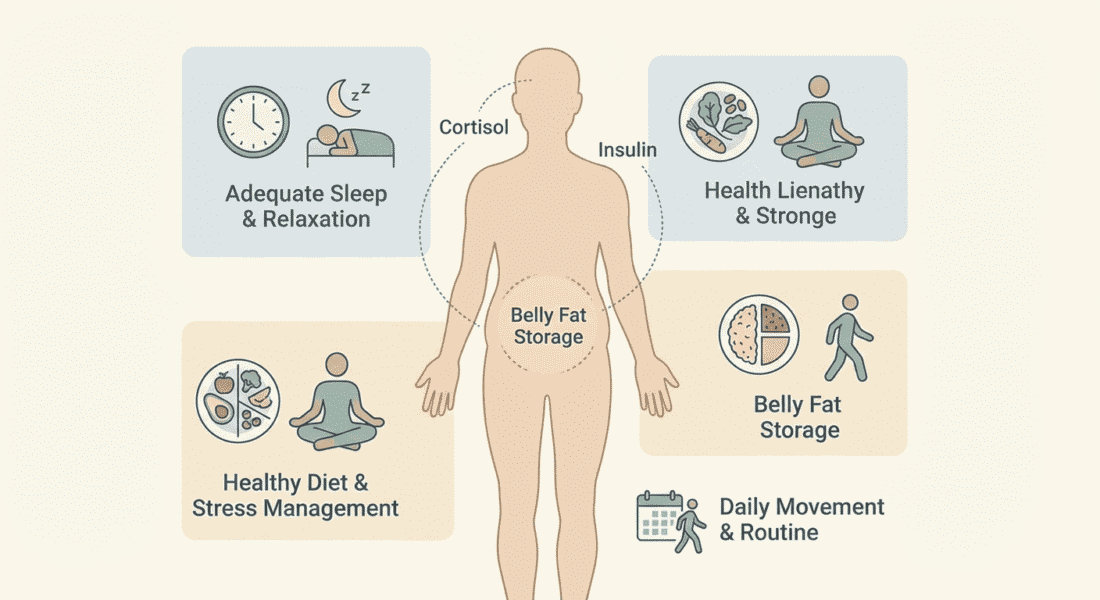
Hormones, Stress & Belly Fat: What You Must Fix First
Author: Dr. Shaista Kamal, MBBS
Credentials: Medical Doctor (MBBS), Lifestyle & Preventive Health Writer
Experience: 6+ years working with metabolic health, stress-related weight concerns, and public health education
A calm starting point (before advice begins)
If you’ve been eating “reasonably well,” trying to stay active, and still notice belly fat that doesn’t respond the way you expect, you’re not alone. Many people experience this and quietly assume they’re doing something wrong—or not trying hard enough.
In real-world settings, belly fat concerns often show up after stress, sleep disruption, hormonal shifts, or long periods of mental strain, not simply because of food choices or motivation. That can be frustrating, especially if past attempts focused only on dieting or exercise without lasting results.
This article is designed to reset expectations early: belly fat is not always a willpower issue. For many adults, it’s closely tied to how the body responds to stress and hormonal signals. Understanding what to address first can prevent wasted effort and unnecessary self-blame.
What do hormones actually have to do with belly fat?
Hormones act as messengers that tell the body when to store energy, when to release it, and how to respond to stress. When these signals are repeatedly disrupted, fat storage—particularly around the abdomen—can become more likely.
Public health guidance from organizations such as the World Health Organization (WHO) and National Institutes of Health (NIH) consistently emphasizes that weight regulation is influenced by stress physiology, sleep, metabolic hormones, and lifestyle patterns, not calories alone.
Importantly, this does not mean hormones are “broken.” In practice, they often reflect the body adapting to long-term pressure.
Stress & fat storage: why cortisol matters
How stress shifts fat storage toward the abdomen
Cortisol is commonly called the “stress hormone.” It plays an essential role in survival, helping regulate blood sugar, blood pressure, and energy availability. Problems arise when cortisol remains chronically elevated.
In real-world observations, prolonged stress—work pressure, financial strain, caregiving, poor sleep—can signal the body to hold onto energy, especially in the abdominal area.
Clinical guidance from the Endocrine Society explains that elevated cortisol can:
-
Increase appetite and cravings for quick energy
-
Promote fat storage around internal organs (visceral fat)
-
Interfere with insulin sensitivity over time
This helps explain why stress weight gain often appears even without major dietary changes.
Why “just exercise more” doesn’t always help
Intense or excessive exercise without adequate recovery can add to cortisol load, particularly when combined with sleep deprivation. Commonly observed among adults under pressure, this pattern can stall fat loss rather than accelerate it.
Hormonal triggers linked to belly fat (beyond stress)
Insulin and abdominal fat
Insulin helps move glucose from the bloodstream into cells. When insulin sensitivity decreases—often due to chronic stress, irregular eating, or sleep loss—the body may store more fat centrally.
According to guidance from the American Diabetes Association, insulin resistance is associated with increased abdominal fat, even in people who are not overweight overall.
This is why insulin belly fat is often discussed separately from general weight gain.
Other hormonal shifts that influence weight
In practice, belly fat accumulation is commonly observed during:
-
Perimenopause and menopause
-
Andropause-related testosterone changes
-
Thyroid function fluctuations
-
Long-term inflammation or illness recovery
It’s important to note that not all hormonal imbalance weight changes require medical treatment—but some may benefit from professional evaluation.
Lifestyle fixes that support hormones first (not extremes)
Rather than chasing quick fixes, public health bodies emphasize repeatable habits that stabilize hormonal signals over time.
1. Prioritize sleep consistency (not perfection)
Sleep disruption directly affects cortisol and insulin regulation. The Centers for Disease Control and Prevention (CDC) recommends consistent sleep timing as a foundational metabolic support.
In real-world settings, even improving sleep regularity by 30–60 minutes can reduce stress-driven eating patterns.
2. Reduce stress input before increasing effort
Stress management does not require meditation retreats. Commonly effective approaches include:
-
Short daily walks
-
Screen-free wind-down time
-
Predictable meal routines
-
Lower-intensity movement on high-stress days
Consistency matters more than intensity.
3. Eat to stabilize blood sugar
Rather than restrictive dieting, professional guidelines favor:
-
Regular meals
-
Balanced combinations of protein, fiber, and fats
-
Avoiding long fasting periods during high stress
This approach supports insulin signaling without extreme control.
When supplements help (and when they don’t)
Some supplements are often marketed for hormones and belly fat. Evidence for most remains mixed or context-dependent.
Professional bodies such as the National Center for Complementary and Integrative Health (NCCIH) note that:
-
Supplements may offer modest support in specific deficiencies
-
They do not override sleep deprivation, chronic stress, or inconsistent eating
-
Individual response varies widely
If considered, supplements should be viewed as optional support, ideally discussed with a qualified healthcare professional—especially for those with existing conditions or medications.
How long does hormonal belly fat take to change?
This is one of the most important expectation-setting points.
In practice, hormonal-related belly fat often responds slowly, over weeks to months, not days. Plateaus are common and do not mean failure. Commonly observed patterns include:
-
Improved energy before visible fat loss
-
Reduced cravings before waist changes
-
Gradual redistribution rather than rapid reduction
This timeline aligns with how the body prioritizes safety and stability. But this slower timeline is one reason abdominal fat is often harder to lose compared to weight in other areas of the body.
When to consider medical guidance
If belly fat is accompanied by symptoms such as:
-
Persistent fatigue
-
Irregular cycles
-
Hair loss
-
Significant unexplained weight changes
Professional evaluation may be appropriate. Clinical guidelines emphasize ruling out underlying conditions rather than assuming lifestyle failure.
A steady, long-term perspective
Belly fat connected to hormones and stress is not a personal flaw. It is often the body responding exactly as it was designed to—protectively, not maliciously.
Progress here is non-linear, personal, and adaptable. Supporting hormones means working with the body rather than fighting it. Over time, consistent, moderate changes tend to outperform aggressive strategies.
If there’s one principle worth keeping: fix the signals first, and the outcomes often follow—gradually, realistically, and sustainably.