
How Long to Lose Belly Fat? A Realistic Timeline That Actually Works
Author: Dr. Ayesha Rahman, MSc Nutrition, PhD (Metabolic Health)
Experience: 12+ years in clinical nutrition and public health research
Reviewed by: James O’Connor, RD, CSSD
Qualification: Registered Dietitian, Certified Specialist in Sports Dietetics
Expertise: Body composition, sustainable fat loss, metabolic health
A calm, honest starting point
If you’ve been trying to lose belly fat and feel confused, impatient, or quietly discouraged, that reaction is understandable. In real-world settings, many people follow advice consistently for weeks and see little visible change—especially around the midsection. That doesn’t mean you’re doing something wrong.
Belly fat behaves differently from fat stored elsewhere. Progress is often slower, less linear, and harder to notice day to day. This article sets realistic expectations early, explains why timelines vary significantly, and outlines practical ways to support progress without resorting to extreme measures or making false promises.
Realistic timelines for belly fat loss
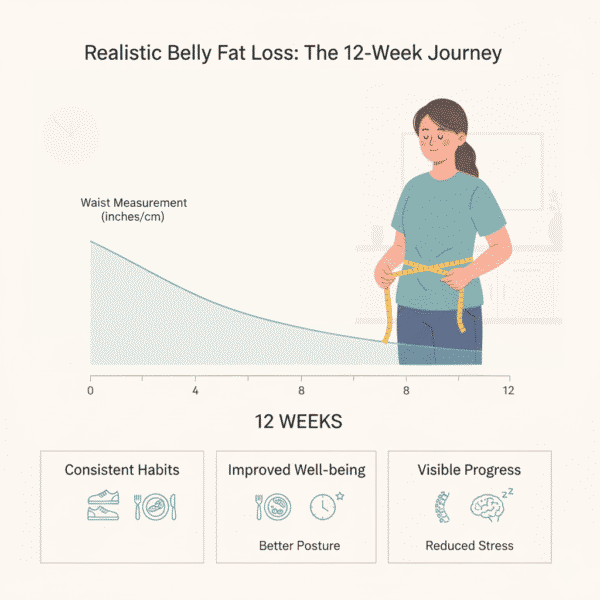
Short answer: Most people notice early internal changes within 4–8 weeks, visible reduction typically appears around 8–12 weeks, and more meaningful changes often take 3–6 months of consistent habits.
What happens first (weeks 1–4)
In practice, the earliest changes are usually metabolic and behavioral, not visual:
-
Improved energy levels
-
Better appetite regulation
-
Reduced bloating or water retention
These changes matter, even if the mirror doesn’t reflect them yet.
When visible change often appears (weeks 8–12)
According to guidance from the Centers for Disease Control and Prevention (CDC) and National Institutes of Health (NIH), safe fat loss usually averages 0.25–0.5 kg (0.5–1 lb) per week. Because abdominal fat is hormonally sensitive, it often reduces later than other areas.
Longer-term outcomes (3–6 months)
Commonly observed among individuals who maintain consistent routines:
-
Reduced waist circumference
-
Improved insulin sensitivity
-
Better long-term weight stability
Public health bodies like the World Health Organization (WHO) emphasize that gradual fat loss is more sustainable and metabolically protective than rapid approaches.
Why do so many people quit early?
It’s because belly fat sometimes doesn’t go away? Understanding this pattern can prevent unnecessary self-blame.
1. Belly fat responds last
In real-world settings, the abdomen is often the last area to show change, the role of hormones in belly fat storage, and even when overall fat loss is occurring.
2. Scale weight hides progress
Muscle retention, water shifts, and digestive changes can mask fat loss on the scale—especially in the first month.
3. Expectations are shaped by hype
Fast belly fat reduction is frequently over-promoted online. Professional consensus bodies like the American College of Sports Medicine (ACSM) consistently note that spot reduction is not physiologically supported.
4. Motivation drops before results appear
Behavioral research shows motivation often declines around weeks 3–6—precisely when visible results are still developing.
How to accelerate results safely (without extremes)
Acceleration here means supporting your body’s natural fat-loss processes, not forcing faster outcomes.
1. Prioritize consistency over intensity
In practice, people who choose “manageable daily habits” outperform those who rely on bursts of extreme effort.
Examples:
-
Daily walking instead of sporadic high-intensity workouts
-
Regular meal timing instead of aggressive restriction
2. Strength training matters
Professional guidelines from the ACSM and WHO recommend resistance training at least 2 days per week. Preserving muscle helps improve metabolic rate and long-term fat loss efficiency.
3. Sleep and stress regulation are not optional
Clinical nutrition research consistently links:
-
Poor sleep → higher abdominal fat storage
-
Chronic stress → elevated cortisol, which favors belly fat retention
Improving sleep quality alone has been shown to influence waist circumference over time.
4. Nutrition adjustments, not overhauls
Rather than drastic diets, commonly effective shifts include:
-
Adequate protein intake for satiety
-
Fiber-rich foods for appetite control
-
Reducing ultra-processed foods when possible
The NIH and WHO both emphasize dietary patterns over rigid rules.
Support tools & products
Some individuals choose non-essential support tools—such as fitness trackers, meal-planning apps, or supplements—to help with adherence. These tools may support consistency, but do not replace foundational habits.
If considering supplements, professional bodies like the NIH Office of Dietary Supplements advise:
-
Checking ingredient transparency
-
Avoiding products promising rapid or targeted fat loss
-
Consulting a qualified professional when unsure
Educational value should remain intact even without any product use.
Key reminders for long-term success
-
Belly fat loss is often slower but not impossible
-
Early progress may be felt before it is seen
-
Plateaus are common and temporary
-
Sustainable routines outperform aggressive tactics
In real-world settings, the most reliable results come from people who stop chasing speed and start supporting consistency.
A supportive closing perspective
Reducing belly fat is less about forcing change and more about creating conditions where change can happen naturally. Progress is personal, non-linear, and influenced by factors beyond willpower alone.
If your efforts feel slow, that does not mean they are ineffective. With steady habits, realistic timelines, and patience, meaningful change is not only possible—it’s far more likely to last.
You’re not behind. You’re building something sustainable.
FAQs
How long does it realistically take to lose belly fat?
For most people, noticeable belly fat reduction takes 8–12 weeks, while more significant changes often require 3–6 months of consistent habits. Early improvements usually happen internally—such as better energy or reduced bloating—before visible changes appear.
Why does belly fat take longer to lose than fat in other areas?
Belly fat is strongly influenced by hormones, stress levels, sleep quality, and insulin sensitivity. In real-world settings, this makes abdominal fat more resistant and often the last area to visibly change.
Can you lose belly fat faster without extreme dieting?
You may support faster progress by improving sleep, stress management, strength training, and dietary consistency, but there is no reliable way to safely force rapid belly fat loss. Public health guidelines consistently discourage extreme calorie restriction.
Is it normal to lose weight but not belly fat at first?
Yes. This pattern is commonly observed. Overall, fat loss may occur before the body releases fat stored around the abdomen. Waist measurements and how clothes fit are often better indicators than the scale alone.
Does walking help lose belly fat over time?
Yes, when done consistently. Walking supports calorie balance, insulin sensitivity, and stress reduction. While it is not a quick fix, it is commonly effective as part of a sustainable routine.
Why do people feel stuck even after weeks of effort?
Plateaus are normal. They often occur due to adaptive metabolism, stress, poor sleep, or unrealistic expectations. In practice, consistency through plateaus matters more than changing strategies too quickly.
Do supplements actually help lose belly fat?
Supplements may support appetite control or routine adherence for some people, but no supplement reliably targets belly fat directly. According to public health guidance, foundational habits matter far more than any product.
How can I tell if my belly fat issue is actually bloating?
Bloating tends to fluctuate daily and is often linked to digestion, while belly fat changes slowly over weeks or months. If the abdomen looks different at different times of day, bloating may be a contributing factor.